
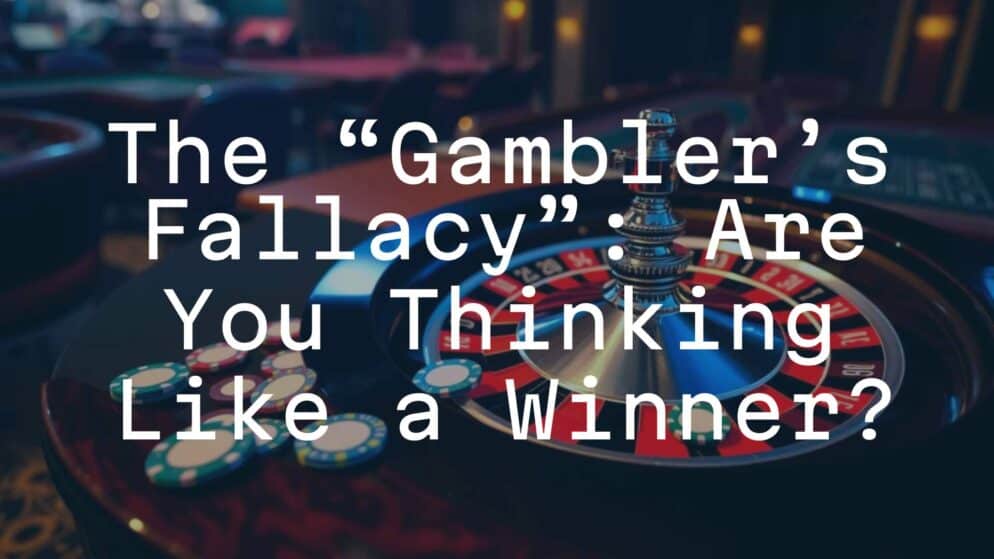
If you think that a long series of losses means you are “due” for a win, you are not thinking like a winner-you are falling into one of the most common thinking mistakes in psychology. People who treat gambling and risk in a clear, logical way know that the universe is not tracking their bad luck. In games of pure chance, the odds of the next result stay the same, no matter what happened before. Thinking like a winner means accepting that randomness has no memory and no duty to “even out” in the short run.
The gambler’s fallacy, sometimes called the Monte Carlo fallacy, is the belief that if a random event happens more or less often than expected for a while, the opposite is more likely to happen soon. This seems like common sense, but it is a math error that has cost people millions of dollars and caused huge frustration. To make better decisions, you need to break this habit and see randomness as it really is: a series of independent events.
What Is the Gambler’s Fallacy?
Why do people think past outcomes affect future randomness?
The human brain is very good at spotting patterns. Long ago, this helped our ancestors survive-like noticing a sound in the grass that meant a predator, or seasonal changes that meant food was coming. But this same pattern-seeking instinct goes wrong with modern games of chance. We want the world to feel predictable and “fair,” so we think random events should quickly “even out.” If a coin lands on heads five times in a row, our gut tells us tails is “overdue,” as if the coin itself is bored of landing on heads.
This comes from what psychologists call the “law of small numbers.” We wrongly expect a small sample of events to match the long-term average of a very large number of events. Over a million coin flips, the result will be close to 50% heads and 50% tails. But that does not mean the next ten flips must come out 5-5. The fallacy tricks us into thinking “luck” has to turn, and we forget that each flip starts fresh with the same odds as the first one.

What makes the gambler’s fallacy a cognitive bias?
The gambler’s fallacy is a cognitive bias because it is a repeated pattern of faulty thinking that affects how we decide and judge situations. It connects to something called the “representativeness heuristic”-a mental shortcut where we judge how likely something is based on how much it matches what we think a “typical” outcome should look like. For example, if we think a random roulette sequence should look like “Red-Black-Red-Black,” then a streak like “Red-Red-Red-Red” feels wrong and more likely to stop.
This bias is more than just weak math skills; it is built into how our brains handle information. Even people who know probability rules can feel a strong sense that a win is “owed” to them. This error in thinking takes a complex idea-probability-and squeezes it into a simple story about balance and fairness. That story often leads to bad money choices and extra risk-taking.
Psychological Causes and Variations of the Gambler’s Fallacy
Origins: Where does the fallacy come from?
Researchers have studied the gambler’s fallacy for centuries. One early description came in 1796 from Pierre-Simon Laplace in his book A Philosophical Essay on Probabilities. He noticed that expectant fathers, after hearing that many boys had been born recently in their village, thought they were more likely to have a girl. They assumed that the “boy-girl ratio” had to stay steady month by month, forgetting that each birth is a separate event.
The most famous case happened on August 18, 1913, at the Monte Carlo Casino. In roulette, the ball landed on black 26 times in a row. As the streak grew, gamblers poured money onto red, sure that black “had to” stop. They lost millions of francs. The chance of 26 blacks in a row from the start was about 1 in 68.4 million. But once 25 blacks had already happened, the chance of the 26th spin being black was still about 50%. The casino made a huge profit that night, and the event helped make the term “Monte Carlo fallacy” widely known in psychology.

How does the brain process randomness?
Brain studies suggest the gambler’s fallacy is linked to specific brain systems. Using fMRI scans, researchers saw that after a “riskloss” (like losing a bet), the frontoparietal network-linked to planning and goal-focused thinking-lights up. This shows the brain working hard to find a “reason” or “plan” to fix the loss, which can push people into more impulsive risks.
At the same time, areas such as the amygdala, which help guide emotional decisions, show less activity after losses. Higher amygdala activity is actually linked to less tendency to fall for the gambler’s fallacy. This suggests the fallacy is driven more by the thinking part of the brain trying to outsmart random events with faulty logic, rather than by pure emotion. In short, the brain’s push to “solve” a random problem is what leads it off track.
How is the gambler’s fallacy related to the hot hand fallacy?
The gambler’s fallacy is about expecting the opposite of a recent result (negative recency). The “hot hand fallacy” is the mirror image: people expect a streak to keep going (positive recency). You often see this in basketball, where fans think a player who has made three shots in a row is “on fire” and more likely to make the next one. The gambler’s fallacy usually applies to things like dice or roulette wheels, while the hot hand fallacy is usually about human performance.
Research shows that people who fall for one of these mistakes often fall for the other. The core problem is the same: trouble accepting that a sequence can be random. Whether you think a streak must end (gambler’s fallacy) or must continue (hot hand), you are still wrongly assuming that past results change the future. In both cases, an “illusion of control” makes people see patterns where there is only noise.
Who Is Prone to the Gambler’s Fallacy?
Types of people affected: Gamblers, judges, sports officials
Despite the name, the gambler’s fallacy reaches far beyond casinos. Research shows it affects many serious jobs. For example, a study of U.S. asylum judges found they were 5.5% less likely to approve an asylum request if they had approved the previous two. Each case should stand on its own, but the judges seemed driven by a quiet sense that they needed to “balance” their choices to look fair.
Sports officials show something similar. Baseball umpires are 1.3% less likely to call a strike if the last two pitches were called strikes. Loan officers, who should rely on hard numbers, are about 8% less likely to approve a loan if they just approved the last one. These patterns show that the gambler’s fallacy is a basic human bias, not limited to obvious “gambling” situations.

What are common situations where the fallacy appears?
Outside casinos and courts, the gambler’s fallacy appears in investing and daily life. Investors often sell stocks after a strong rise, worried that the price is “due” to drop, even when the company’s business remains solid. Parents who have had three boys may think they are “due” for a girl, though the odds of each pregnancy staying near 50/50 do not change.
Video game companies also use this bias. Some games add a “pity timer” to loot boxes. If a player opens several boxes without a rare item, the game quietly raises the chance of a rare drop. This is coded into the game and is not true randomness, but it strengthens the feeling that “a win is coming” if you just keep playing. This can affect younger players in particular, who are still learning how probability and risk really work.
How Does the Gambler’s Fallacy Influence Decision-Making?
Real-life examples: Coin tosses, roulette, and lotteries
A simple example is a coin toss. If you flip a fair coin 20 times and get heads every time, the chance that the 21st flip is heads is still 1/2. But the chance of getting 21 heads in a row from the beginning is 1 in 2,097,152. The fallacy appears when we mix up the chance of the whole streak with the chance of each single flip. Once those 20 heads are already in the past, their chance is no longer in question-they already happened. They do not affect the next toss.
Lottery players act in a similar way. After a certain set of numbers wins, many players avoid those same numbers in the next draws, as if they are “used up.” But the balls in the machine do not remember last week’s draw. The same combination can appear again with the same tiny chance as any other specific set of numbers.
Why do casino wins and losses reinforce faulty logic?
Casinos are carefully set up to take advantage of thinking errors. One major tool is the “near miss.” On a slot machine, when two “7s” line up and the third one stops just off the payline, the brain reads this as being “close” to a win. From the brain’s point of view, a near miss can feel almost as rewarding as a real win. It creates a feeling that you are “getting close” or that the machine is “warming up.”
Lights, music, and sounds for every small win add to this effect. Our brains hold on to win memories longer and more clearly than loss memories. This creates a false inner record where you recall the rare big win after a slump but forget the many long losing stretches while “waiting” for that win. This skewed memory keeps the gambler’s fallacy alive, making people think their “system” or patience caused the win.
What is the difference between independent and dependent events?
To avoid the gambler’s fallacy, you need to know the difference between independent and dependent events.
- Independent events: One outcome does not affect the next. Examples:
- Roulette spins
- Coin tosses
- Dice rolls
The roulette wheel does not “know” its past results. In these cases, expecting a “correction” is always an error.
- Dependent events: One outcome changes the odds for the next. Example:
- Blackjack from a single deck without reshuffling. When an Ace is dealt, fewer Aces remain, so the chance of another Ace goes down.
This is why card counting can work-it uses real shifts in probability.

The gambler’s fallacy happens when people treat independent events like they are dependent, acting as if the system has a memory when it does not.
Dangers, Risks, and Misconceptions
How does the gambler’s fallacy fuel addiction and risky behavior?
The most harmful form of this fallacy is “chasing losses.” If someone believes they are “due” to win, they may raise their bets after losing to try to win back what they lost. This can start a steep downward spiral. Thinking the odds are shifting in their favor, they feel justified betting money meant for rent, bills, or daily living. This thinking pattern is a major factor in severe gambling problems.
For athletes and very competitive people, this can be worse. Athletes are taught to push harder when they are behind. That works in sports, where effort and skill matter. But in a casino, there is no amount of effort that can change the math. Treating gambling like a test of will or toughness often leads people to double or triple their bets, refusing to walk away.
Distinguishing non-examples: Changing probabilities and outcome dependence
Not every judgment based on past events is a fallacy. In sports betting, a golfer’s recent performance or history at a certain course can be a real guide to future results. Human performance depends on skill, health, and mental state, so past results can affect future chances.
Also, if a coin is flipped 50 times and lands on heads 45 times, it makes sense to suspect the coin is biased. In that case, using past results to predict the future is reasonable. A careful thinker using Bayesian reasoning would guess that the coin is not fair. The gambler’s fallacy only applies when you know the process is fair and random, but you still expect some “payback” from the universe.
What are the warning signs of falling into this fallacy?
Spotting early signs can keep a casual hobby from turning into a serious problem. Warning signs include:
- Feeling a strong push to bet more after a loss.
- Using phrases like “I’m due,” “My luck has to change,” or “This machine is hot.”
- Relying on “lucky” habits, objects, or sayings to influence results.
- Hiding how much time or money you spend gambling from friends or family.
- Borrowing money or using credit to keep playing, hoping for a “big win” to fix everything.
If you feel restless or angry when you stop gambling, or if you spend a lot of time daydreaming about the next big win, these are signs that this fallacy may be shaping your behavior.
How Can You Avoid Thinking Like a Loser?
Actionable tips to recognize and prevent the gambler’s fallacy
One helpful method is to stop grouping bets into “sessions.” Instead of thinking of your whole night at the casino as one long story where you are “down” or “up,” treat each bet as a separate event. If you see every spin, roll, or hand as a fresh start, the urge to chase losses gets weaker. What happened before is over; it does not change what comes next.
Another useful step is keeping a simple record. Because our minds highlight wins and fade out losses, an honest log of your time and money is very helpful. Use an app or a notebook to track every bet and result. Clear numbers in front of you can break the feeling that you are “about even” or “always close” when the truth is different.
Strategies to promote rational thinking in gambling and life decisions
Think of gambling as paid entertainment, not a way to earn money. You would not go to a concert expecting to leave richer than you arrived-you pay for the experience. Set a firm budget using only money you can safely spare. Once that money is gone, the activity is over. This attitude removes the pressure to “get back to even.”
Learning about randomness and probability can help, even though knowledge alone does not fully erase the bias. Practicing “mindful gambling” can make a real difference: notice your thoughts while you play. If you catch yourself thinking “red is due,” stop and say to yourself, “The wheel does not remember anything.” That brief pause can stop a bad string of choices before it grows.
Frequently Asked Questions about the Gambler’s Fallacy
Is the next outcome truly independent in random games?
Yes. In games like roulette, craps, and most modern slot machines (which use Random Number Generators, or RNGs), each outcome is independent. The machine or wheel does not “remember” previous results or care how long it has been since the last jackpot. The RNG makes new numbers every moment, and each new result is separate from the last. The only time outcomes are linked is when the game uses a limited set of items that are not fully replaced, such as cards in a single-deck Blackjack game.
Does the gambler’s fallacy affect everyone equally?
Research suggests that people with higher IQ scores may sometimes be more likely to fall for this fallacy. Because they are good at spotting patterns, they may overanalyze random events and see structure where none exists. They might build complex stories about “trends” in situations that are actually random. Also, this bias tends to drop with age. College students, for example, are less likely to fall for it than younger children, as their grasp of probability improves over time.
How can awareness improve your chances of winning-or at least not losing?
Knowing about the gambler’s fallacy does not change the built-in odds of any game, but it does change how you act. If you accept that you are never “owed” a win, you are less likely to raise your bet size during a losing streak. This helps you avoid rapid, large losses. Thinking like a winner means knowing when to stop, seeing “luck” as normal ups and downs in random outcomes, and never betting money you cannot afford to lose.
Mastering the psychology of the gambler’s fallacy goes beyond gambling. It helps you see where your intuition fails in any risky choice. Groups like the Gateway Foundation and NICASA Behavioral Health Services work to spread this message, especially to higher-risk groups such as young athletes and college students. Their work with partners like the NFL and NCAA stresses the value of having a clear plan and treating gambling as a pastime, not a job. If you or someone you know is stuck in a cycle of chasing losses, help is available 24/7 at resources like 1-800-GAMBLER. The first step toward peace of mind is accepting that past losses do not push you any closer to the next big win.
About Ahmed Rahman